Showing posts with label Value Stream. Show all posts

Friday, March 6, 2015

Laboratory logistics and process flow


Minimize Motion and Transport Muda in the Lab


Continuous operational flow with streamlined processes is the ideal for any analytical lab. This can be achieved by organising the workspace to reduce time wasted by motion and transport. Creating a motion map or a spaghetti diagram can help understand process flow and identify areas of "traffic", unnecessary journeys, obstacles and bottlenecks - see the map I generated for a PCR process below. Draw a basic floor plan of the facility and map every motion involved in a process - record the amount of time spent in motion and gauge distances. Review the map and data and see how process motion can be improved. Can the workspace be reorganised to minimize the amount of travel? Can instruments be relocated? Can consumables or reagents be stored in more accessible area? Many facilities have shared equipment rooms - can the number of visitations be reduced. Consider batch size also, is it better to process smaller amounts or take several journeys to transport a larger batch? Review transportation methods - if there's a trolley available use it! Motion and transport are huge wastes in laboratories and they also contribute to waiting. Not only is time wasted physically, but sample deterioration can also occur, not to mention opportunities for bioburden to accumulate. So when streamlining an analytical process consider levelling sample loads, ensure that the queuing system is optimized for sample storage and enhance logistics by making equipments an instruments readily accessible to minimize journeys and delays. 

Spagetthi Diagram - Motion Map
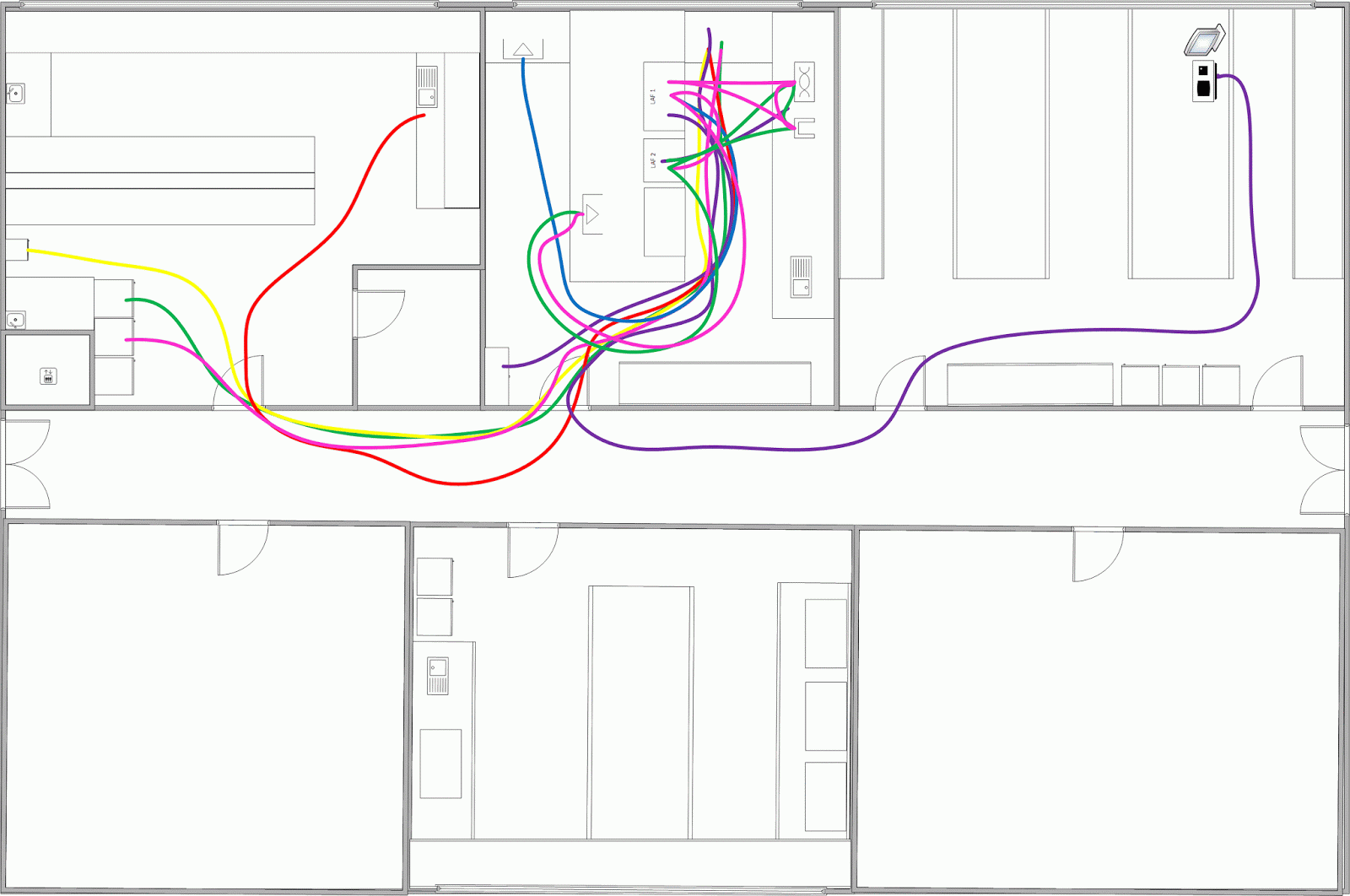

Spaghetti diagram for my qPCR assay.....clearly we need to rearrange a few things!


Time, money and energy is lost in motion!


An optimized process flow with reduced transport and movements can help minimize errors and reduces fatigue for the lab staff. Continuous flow, creates a more streamlined workload and increases productivity. Mapping a process is an essential step of value stream mapping and is very useful in identifying waste, delays and bottlenecks: 

  • Unnecessary motion of people during process sampling
  • Unnecessary transport of personnel, product, sample, reagents, information
  • Inconvenient location of equipment, instruments and materials


Many companies will have a value stream map (VSM) for a product. However it is worth creating a specific VSM for the QC analysis process of that product to help improve laboratory efficiencies. Time is also lost in the transfer of information and data. Processes should be optimized to ensure there is an efficient system in place for sample collection, data processing and delivering data results. An efficient LIMS system will dramatically improve data transfer and reduce waiting. The Kanban tool can be used in conjunction to help visualise the process, particularly where quesues and volatile workloads are involved (refer to Kanban post).


Spaghetti diagram of current workflow and new implemented workflow


Value Stream Map


Creating a current state value stream map is an efficient tool to understand the logistical flow of a process, provide detail on the value of each step and detect non value added elelments with opportunities for Kaizen events - continuous improvement. A VSM illustrates the flow of information, data, processes, inputs outputs and integrates metrics to evaluate value in terms of time and cost. A current state VSM with Kaizen events can be used to project future efficiencies by generating a projected, future state VSM. The illustration below outlines the flow of infomation, materials and lead time. Each individual step in the process includes metrics relating to cycle time and delays. 


Current state VSM can provide details relating to:


First in First Out Processing
  • Queues (backlog) of work items. Queues are organised based on the number of items waiting to be processed. 
  • Queues can be prioritized in several ways, i.e. First-In-First-Out (FIFO) 
  • Wait time - how long a sample is in a queue
  • Work time how long it takes to process/analyse a sample 
  • Identifying bottlenecks and causes of delay 
  • Identify areas of unproductive work, resource imbalances 
  • Areas of automation or manual processing

Current VSM depicting the process flow of a sample from delivery, processing to release of results, with intermittent Kaizen events.


Tuesday, March 3, 2015

Kanban

Kanban is a Japanese word that means “visual card”. Kanban is a system for organising workflow, task prioritisation and effective use of personnel and resources for just in time delivery (JIT). JIT sample analysis is enhanced by automation, efficient sample levelling and continuous operatioal flow.


1. Process visibility


In a Kanban system it is important to visualize the work flow. This may involve creating a Kanban board, dividing the work process in to smaller steps, each step is identified by a specific coloured card. The card contains the information about the process and the person responsible. The cards are placed on a workflow (Kanban) board outlining samples waiting for analysis, queued, work in progress (WIP), completion and release so that the process flow and progress is clearly visible.


2. Limited WIP (work in progress)


In the Kanban system, increasing the visibility of a process and task status makes it easy to identify backlogs, constraints, overburdened employees and bottlenecks. The system sets specific limits for how many items may be processed at any time. In this way tasks are completed just in time (JIT) to limit backlog.


3. Monitor lead time 


The Kanban system optimizes processes by predicting workflow and reducing the lead time - average amount of time it takes for a task to be processed from the specific start to the finish point. In laboratoty terms, this can relate to the amount of time it takes to process a batch from collection, sample analysis and data transfer. Kanban metrics can be used to analyze the time required to process samples to make improvements for an efficient continous flow operation.


4. Make Process and Policies Explicit

Lead and cycle time diagram by Kanban Tool

Processes need to be clearly defined, explicit and communicted effectively in order to be understood. Without clear ojectives and general consensus, people are less likely to engage in process improvement and and adopt changes.


5. Collaborative Improvement


The success of Kanban requires small incremental changes for continuous improvement and sustainment. Team engagement and a holistic approach to continuous improvment throughout the facility is essential.


Kanban Inventory 


Managing inventory is an important aspect of minimising waste in laboratories and it complements the 5S initiative. A Kanban system may be used for inventory maintenance, particularly restocking. Other inventory examples where Kanban is apparent include colour indictors for different samples according to urgency or batch, a common practice in clinical labs. 


Kanban Board


A Kanban board is an effective visual management tool that provides an excellent overview of a current work situation by making process flow, tasks and responsibilities clearly visible. It enables clear identification of backlogs, heavy workloads, overburdened resources and personnel. It is also an excellent way for employees to keep track of their own progress and work load management and it simplifies communication within a team to enhance productivity.


Kanban board


There are also numerous digital Kanban software programs which may be a good tool for integration with LIMS to enhance communication and collaborate analyses in real time.


    http://leankit.com/kanban
Kanbanize
   https://kanbanize.com/


Wednesday, February 25, 2015

Six Sigma


Six Sigma is a methodology for quality improvement based on reducing defects and process variation. 


Six Sigma was initially implemented by Motorola and has become a popular management and process improvement strategy. The successful adoption of Six Sigma methodology by Jack Welch at General Electric has instilled a strong sense of Six Sigma philosophy across many industries. In statistical terms, Six Sigma refers to the the study of process capability, a Six Sigma process has less than 3.4 DPMO (defects per million orders) and there are six standard deviations between the mean and the nearest specification limit (upper or lower specification limit).


Six Sigma Methodology


Six Sigma has a strong emphasis on statistical analyses, metrics and the DMAIC approach to problem solving: define, measure, analyze, improve, and control. DMAIC is central to any process improvement intitative. 

The ASQ definitions of DMAIC

  • Define the problem, improvement activity, opportunity for improvement, the project goals, and customer (internal and external) requirements.
  • Measure process performance.
  • Analyze the process to determine root causes of variation, poor performance (defects).
  • Improve process performance by addressing and eliminating the root causes.
  • Control the improved process and future process performance. 


Six Sigma and lean philosophy are contiguous, both strive towards quality and process improvement with similar strategies. Six Sigma utilises empirical measures and statistical analyses to detect and eliminate defects and process variation. Lean is primarily focused on waste minimisation and value. Both systems operate in synergy for maximum efficiency, productivity and quality improvement.


Implementing a Lean Six Sigma Project in your company and laboratory


Six Sigma Organisation


Six Sigma Hierarchy
An effective Six Sigma (SS) project is reliant on knowledge of Six Sigma philosophy and statistics, successful use of the tools and metrics, team engagement and commitment from all stake holders. In a Six Sigma organisation there is a hierarchy of members that are involved in Six Sigma initiatives, ranging from the Champions or Sponsors to Black belt leaders and team members. Six Sigma project requires support from management and company executives i.e. Champions or enables that provide resources for SS implementation. A Master Black Belt (MBB) is a highly skilled and experienced Black Belt who is an expert in the use of Six Sigma tools and statistics. The MBB is a mentor to other black belts and is responsible for the management and implementation of numerous Six Sigma programs. Black Belts lead Six Sigma projects and are highly skilled in Six Sigma methodologies with extensive knowledge of the use of statistics, SS tools and project management. Green belts are trained in Six Sigma methodologies and statistics; Green Belts generally assist Black Belts on large projects or lead smaller projects. Team members also include Yellow Belts, White Belts and process owners who assist in project realisation and effective implementation of Six Sigma

Team Lean Sigma

Defining the problem and goals are the first steps in the DMAIC cycle to continuous improvement! After defining the project a Lean Six Sigma team must be established. Leadership and team commitment is critical to the success of a project. Toyota House of Quality emphasises employee empowerment and respect for people, two attributes which contribute Lean Six Sigma (LSS) success. When establishing a team for a LSS project in your laboratory it is important that members range from having a diverse skills background to subject matter experts. Members should adopt a culture of LSS culture and be involved in assisting with data collection and feel "empowered" to implement changes for process improvement.  Regular meetings must be scheduled to ensure consistent deployment of LSS tools, data collection metrics analysis, review progress and present results. The use of tools and statistics at all stages of the DMAIC process is the main strategy towards Lean Six Sigma deployment .

Lean Sigma Toolbox


Tuesday, February 24, 2015

Lean manufacturing, Lean thinking, Lean culture...

What is Lean?


Lean is typically associated with waste minimization, continuous improvement and respect for people. All of these measures contribute to more productive and efficient processes. Lean manufacturing is modelled on the Toyota Production System (TPS).


A leaner laboratory can make significant improvement in routine testing and analyses. Lean is already widely adopted to the manufacturing industry where many processes have benefited from continuous improvement projects. The laboratory is no exception! Whether it’s a clinical, diagnostic, analytical, quality control or microbiology lab, a lean lab will result in: 


  • Enhanced productivity
  • Reduced waste (muda)
  • Increased throughput
  • Faster turnaround times (TAT) 
  • Significant cost reductions!
  • Better employee morale


5 Lean Principles 


  1. Value: define what is of value to the customer
  2. Value Stream: identify the value stream, eliminate waste
  3. Flow: Create a constant flow
  4. Pull: Produce on demand
  5. Perfection: Continuous improvement


Continuous Improvement - Kaizen


By adopting a Lean culture, laboratory processes can be improved significantly. Identifying and eliminating waste can really reduce costs. When the lab and processes are optimized in the Lean Six Sigma way, lab life is made a lot simpler and more productive. The Lean culture has a strong emphasis on respect for people – continuous improvement relies on this attribute. The lean culture values the process owners - i.e. lab technicians, scientists, supervisors etc. and has a policy of empowerment, each individual is responsible and engaged in a team effort to ensure continuous improvement or Kaizen. A lean lab should be an enhanced and more simplified productive environment with the added advantage of boosting morale.


Principles of Kaizen