Showing posts with label Continuous Improvement. Show all posts

Friday, March 6, 2015

Lean Kata


Kata is the Japanese word that means form. A Kata is a detailed choreographed ritual of movements traditionally practiced in martial arts. The skills are handed down from master to student over many generations. Kata is a pattern of behavior, when practiced repetitively it becomes second nature. It is commonly referred to the Toyota Kata and is defined as an integral tool of change throughout the whole company. The key to Kata is habit. In Lean terms, Kata is a routine, standardized, synchronised process, it includes Improvement Kata (IK) and Coaching Kata (CK).


“The systematic pursuit of desired conditions by utilizing human capabilities in a concerted way.”

Mike Rother, author Toyota Kata


Improvement Kata


Kata is an important aspect of a Lean laboratory to implement Kaizen, standardize and sustain Lean initiatives. An improvement Kata is a strategy of moving from a current condition to a new situation in a systematic, directed, meaningful way.

It is based on a four step procedure:

    • Understand the Direction
    • Grasp the Current Condition
    • Define the Next Target Condition
    • PDCA - Plan Do Check - toward the Target Condition


           Simple Kata routines in the laboratory could include:

          • Gemba - Regular Gemba  ensures that a Lean culture is being implemented through practice and training. For instance, observe 5S, Kaizen projects  and other lean initiatives in the lab.

          • Sustainment - sustain successful Kaizen programs - delegate responsibilities and implement regular audits. 
          • Repeat and implement - replicate sustained improvements in other processes.
          • Bottom-up Improvement - improvement that happens outside of a Kaizen event, start small and build small incremental changes towards improvement. This may involve something simple like relocating an instrument to streamline a process and reduce muda (waste).


          Coaching Kata


          The Coaching Kata supports Improvement Kata by encouraging learning and training to improve the current condition and ensure that porgress is being made townards the target. Coaching Kata is instrumental in the fourth step of the Improvement Kata, PDCA (Plan, Do, Check, Act) towards attaining the Target Condition. The Coaching Kata question cards are an excellent resource to support IK.


          The IK Reference Guide 

          by Mike Rother


          Further information and resources


          Check out the Toyota Kata and the Kanban Kata.

          I love Lego so I highly recommend these Kata presentations by Hakan Forss.


          Tuesday, March 3, 2015

          Kanban

          Kanban is a Japanese word that means “visual card”. Kanban is a system for organising workflow, task prioritisation and effective use of personnel and resources for just in time delivery (JIT). JIT sample analysis is enhanced by automation, efficient sample levelling and continuous operatioal flow.


          1. Process visibility


          In a Kanban system it is important to visualize the work flow. This may involve creating a Kanban board, dividing the work process in to smaller steps, each step is identified by a specific coloured card. The card contains the information about the process and the person responsible. The cards are placed on a workflow (Kanban) board outlining samples waiting for analysis, queued, work in progress (WIP), completion and release so that the process flow and progress is clearly visible.


          2. Limited WIP (work in progress)


          In the Kanban system, increasing the visibility of a process and task status makes it easy to identify backlogs, constraints, overburdened employees and bottlenecks. The system sets specific limits for how many items may be processed at any time. In this way tasks are completed just in time (JIT) to limit backlog.


          3. Monitor lead time 


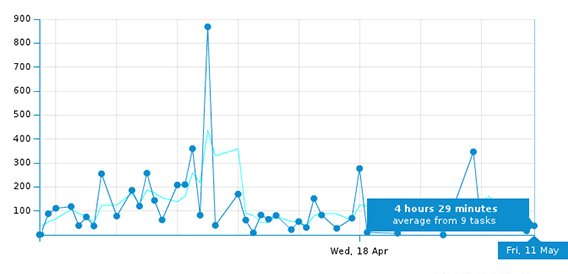
          The Kanban system optimizes processes by predicting workflow and reducing the lead time - average amount of time it takes for a task to be processed from the specific start to the finish point. In laboratoty terms, this can relate to the amount of time it takes to process a batch from collection, sample analysis and data transfer. Kanban metrics can be used to analyze the time required to process samples to make improvements for an efficient continous flow operation.


          4. Make Process and Policies Explicit

          Lead and cycle time diagram by Kanban Tool

          Processes need to be clearly defined, explicit and communicted effectively in order to be understood. Without clear ojectives and general consensus, people are less likely to engage in process improvement and and adopt changes.


          5. Collaborative Improvement


          The success of Kanban requires small incremental changes for continuous improvement and sustainment. Team engagement and a holistic approach to continuous improvment throughout the facility is essential.


          Kanban Inventory 


          Managing inventory is an important aspect of minimising waste in laboratories and it complements the 5S initiative. A Kanban system may be used for inventory maintenance, particularly restocking. Other inventory examples where Kanban is apparent include colour indictors for different samples according to urgency or batch, a common practice in clinical labs. 


          Kanban Board


          A Kanban board is an effective visual management tool that provides an excellent overview of a current work situation by making process flow, tasks and responsibilities clearly visible. It enables clear identification of backlogs, heavy workloads, overburdened resources and personnel. It is also an excellent way for employees to keep track of their own progress and work load management and it simplifies communication within a team to enhance productivity.


          Kanban board


          There are also numerous digital Kanban software programs which may be a good tool for integration with LIMS to enhance communication and collaborate analyses in real time.


              http://leankit.com/kanban
          Kanbanize
             https://kanbanize.com/


          Monday, March 2, 2015

          Go To Gemba!


          Observe, Engage, Improve


          Gemba is a Japanese word which means “at the site”. In Lean, Gemba means observing a process in action. The first step in the Lean process is go to Gemba - go and see!


          Identifying muda or waste in the lab is key to successful implementation of lean. In order to identify wastes and defects it is necessary to go to Gemba and observe, engage in the process. Gemba is essentially a waste walk or audit to get an understanding of a situation, process, purpose and people. Improvement can only occur if the situation is adequately understood. There is no point assessing a process from the desk, muda isn’t evident from remote assessment. During Gemba consider SIPOC: Supply Input Process, Output, Control.


          Tuesday, February 24, 2015

          Lean manufacturing, Lean thinking, Lean culture...

          What is Lean?


          Lean is typically associated with waste minimization, continuous improvement and respect for people. All of these measures contribute to more productive and efficient processes. Lean manufacturing is modelled on the Toyota Production System (TPS).


          A leaner laboratory can make significant improvement in routine testing and analyses. Lean is already widely adopted to the manufacturing industry where many processes have benefited from continuous improvement projects. The laboratory is no exception! Whether it’s a clinical, diagnostic, analytical, quality control or microbiology lab, a lean lab will result in: 


          • Enhanced productivity
          • Reduced waste (muda)
          • Increased throughput
          • Faster turnaround times (TAT) 
          • Significant cost reductions!
          • Better employee morale


          5 Lean Principles 


          1. Value: define what is of value to the customer
          2. Value Stream: identify the value stream, eliminate waste
          3. Flow: Create a constant flow
          4. Pull: Produce on demand
          5. Perfection: Continuous improvement


          Continuous Improvement - Kaizen


          By adopting a Lean culture, laboratory processes can be improved significantly. Identifying and eliminating waste can really reduce costs. When the lab and processes are optimized in the Lean Six Sigma way, lab life is made a lot simpler and more productive. The Lean culture has a strong emphasis on respect for people – continuous improvement relies on this attribute. The lean culture values the process owners - i.e. lab technicians, scientists, supervisors etc. and has a policy of empowerment, each individual is responsible and engaged in a team effort to ensure continuous improvement or Kaizen. A lean lab should be an enhanced and more simplified productive environment with the added advantage of boosting morale.


          Principles of Kaizen


          Sunday, February 15, 2015

          Lean Six Sigma in the Laboratory


          Lean manufacturing to Lean analysis - extending the potential of Lean Six Sigma in biopharmacutical industry
          This blog is designed to introduce the concepts and techniques of continuous improvement in laboratory work spaces using Lean Six Sigma tools and techniques to create an efficient and productive. Lean Six sigma is a well established tool in manufacturing and it is gaining imminence in health care and services industries also. Lean Six Sigma can be applied to any project or any facility to improve efficiency by reducing waste, minimizing defects and adopting a philosophy of continuous improvement. In this blog, I will address the benefits of implementing lean six sigma in the laboratory. Lean is not a new concept in the biopharmaceutical industry, as it is adopted by most high profile biomanufacturing companies including Johnson and Johnson, Pfizer, Abbott, Baxter. The practical applications are not merely confined to the production area, it is a culture and methodology that is adopted throughout the industry. This blog will highlight the benefits of Lean Six Sigma in the QC laboratory and explores the tools and techniques that can be used to improve workflow efficiency and create a leaner, more productive quality laboratory.


          Lean Six Sigma in biopharmaceutical QC laboratories creates efficient and productive workflow, reduces waste and increases sampling throughput.